Workforce
October 15, 2026
If Paid Family Caregivers Will Not Finish the Training, Blame the Training

Home health has a playbook for wounds. Heart failure is still waiting for one. HOP connects quality data to education so the nurse learns the why behind every visit.
Home health is excellent at managing ortho patients. Wound care, too. Infusion patients, Foley patients. We do those well.
Here's why: the structure comes with the order. The surgeon dictates the ortho visit pattern. The wound care clinic dictates the wound visits. The physician hands us the playbook, and we execute it.
Chronic disease patients get no playbook. Nobody dictates the visit structure for a heart failure exacerbation or an uncontrolled diabetic. So agencies fall back on a generic pattern and hope it works. It doesn't.
The research on cardiac readmissions shows a bimodal curve. The first peak hits in weeks one and two. Then it tapers. Then it comes back in weeks six and seven. This isn't new. It's been in the literature for years.
And the two peaks have different causes. The first comes from the handoff: falls in those early days home, discharge planning mistakes, medication reconciliation issues. The second peak is on us. By weeks six and seven, the patient is declining and nobody calls. We never taught the patient and the caregiver to pick up the phone at the first sign of trouble. That's a home health failure, not a hospital one.
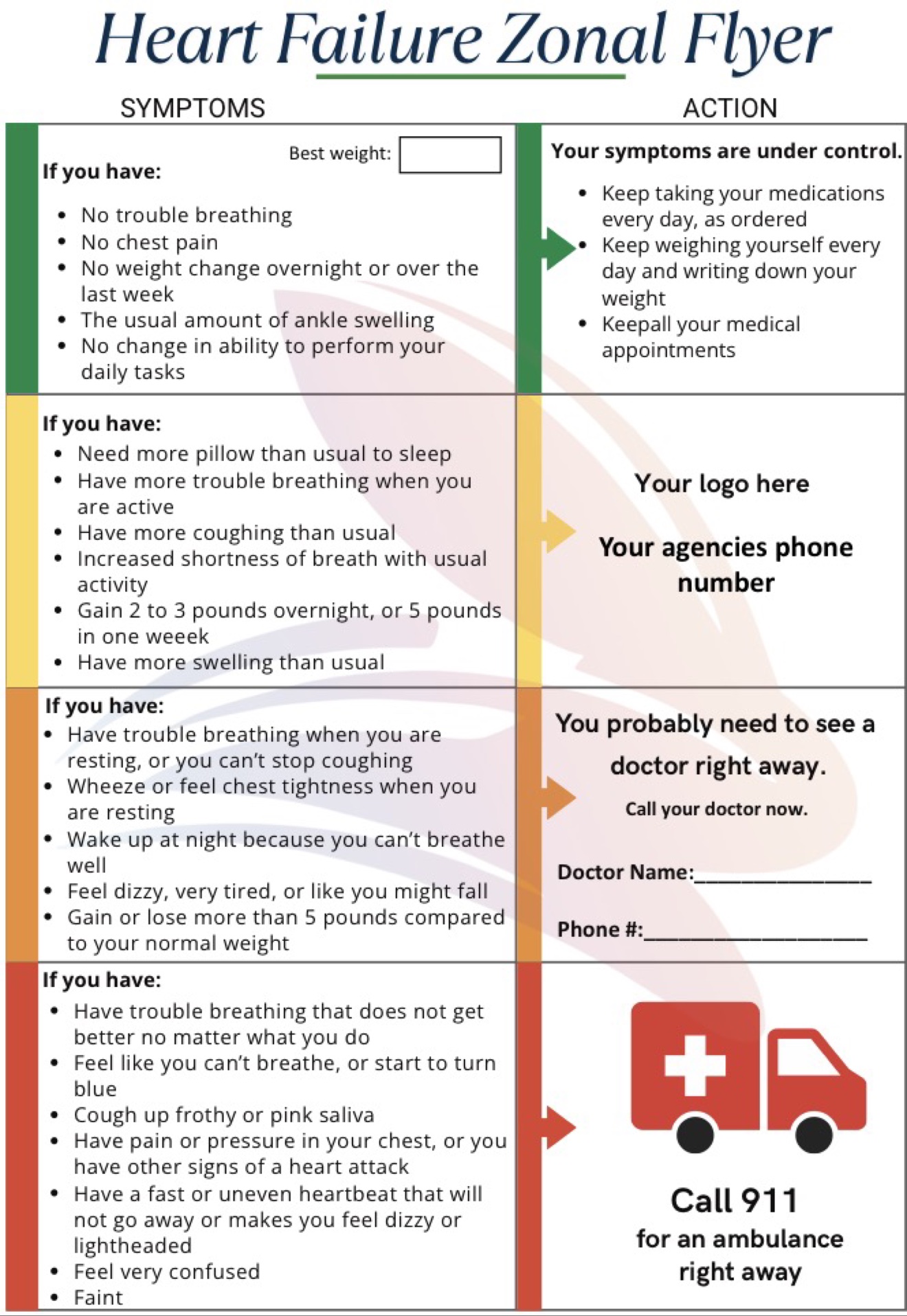
We built a four-zone flyer to plug exactly that gap. Most zonal tools give the patient three zones and leave it at that. Ours gives the clinician their own zone, with clear triggers for when to act before the patient slides. It's not how home health usually does zonal flyers, because the usual ones leave the clinician out of the picture.
So the right visit structure for a cardiac patient is obvious: front-load the first two weeks, taper down, then bring visits back up in weeks six and seven. Instead, most agencies run the generic pattern and discharge at day 30. Then the patient gets readmitted in week six, and the agency's discharge-to-community score tanks. They never connected the two.
This is where home health fails at chronic disease management. Not for lack of knowledge. The knowledge is sitting in journals. It never reaches the frontline clinician with a reason attached. Nobody tells the nurse why she's going three times in week one and twice in week six. So she follows the generic pattern, and the generic pattern is wrong.
And it's not that clinicians don't want to learn. When I used to do these trainings in person, you could see the excitement. "Oh my God, we didn't know that." They lit up.
The problem is that this kind of training only sticks if it happens at a regular cadence. And cadence is exactly what home health can't do. The workforce is too distributed, too disjointed. You can't pull everyone into an office every week and expect anything to stick.
That's why I built HOP.
When an agency's discharge-to-community numbers are low, our system picks it up. We look at length of episode, referral patterns, diagnostic volume. The system connects our quality data to our education: it tags the pattern, we pull the research behind it, and turn it into education the nurse actually receives. Here's the study, here's what it found, here's how your visits should look because of it. The why travels with the what.
For ortho and wounds, the physician writes the structure. For chronic disease, HOP does.

Transform your agency's quality performance with AI-powered micro education that closes gaps, ensures compliance, and empowers your clinical team.



HOP connects quality analytics, compliance tracking, and AI-powered micro education to help home health agencies improve outcomes.
Email : monika@myhop.ai